
Wood pellets are becoming increasingly popular due to their energy efficiency and low environmental impact. But how are these small cylinders of compressed sawdust made? What quality standards must be met? What are the challenges facing the industry? In this article, I’ll provide a comprehensive guide to wood pellet manufacturing to help you better understand this key product in the energy transition. 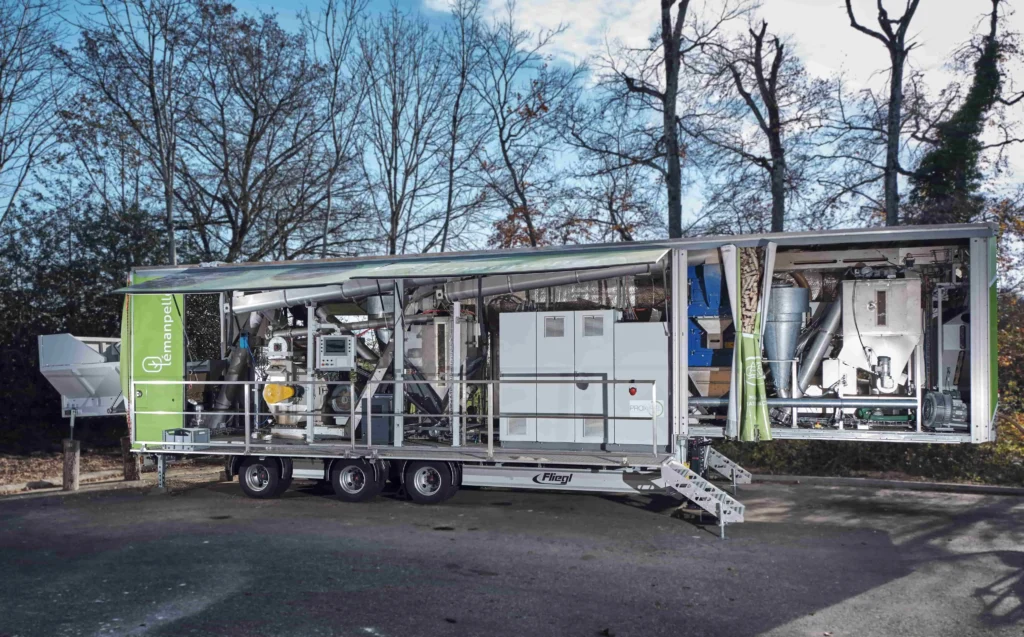
Understanding What a Wood Pellet Is
A wood pellet is a compacted cylinder made of sawdust or wood chips, typically measuring between 6 and 8 mm in diameter and about 10 to 25 mm in length. It is a 100% natural fuel. Its production is based on a simple principle: concentrating the energy of wood into a dense, uniform, and easily transportable form, without the addition of chemical binders. Today, wood pellets are used for:
- home heating (stoves, boilers),
- heat generation in industrial or commercial settings (biomass and multi-fuel boilers),
- more rarely, for specific uses (animal bedding, fertilizer, barbecues, etc.).
A Key Raw Material: Dry Sawdust
It all starts with the choice of raw materials.
Wood pellets are most often made from byproducts of primary wood processing: 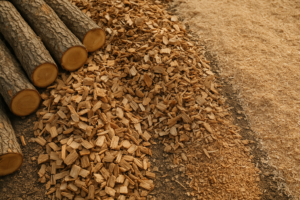
- sawdust (sawmills, planing mills),
- clean chips or shavings,
- To a lesser extent, logs are also sourced from thinning operations—which are necessary for forest maintenance—and from sanitary cutting, which removes diseased or dead trees.
- possibly untreated wood scraps.
- Depending on the type of raw material, different classes of pellets are produced: A1, A2, B. See the article “How to Choose Your Pellets” for more details.
This point is fundamental: to ensure high-quality pellets, it is essential to use virgin wood that has not been treated with chemicals, glue, or paint. The raw material must also be uniform:
- Main component: softwoods (pine, fir, spruce) → excellent natural binding properties (lignin).
- Hardwood can also be used, and it does not affect the quality of the pellets.
- It is sometimes necessary to add a natural additive—cornstarch—to ensure that the pellets hold together well.
- Finally, the raw material must be dried beforehand. The optimal moisture content is around 8 to 12% prior to pelletization.
What kinds of materials can be turned into pellets?
The pelletization process always follows the same basic steps, which we will examine in detail below. However, the requirements vary significantly depending on the feedstock being processed: sawmill residues, miscanthus, poultry manure, or other organic waste. Explore our dedicated content to learn more about each type of biomass.
Grinding Miscanthus
An alternative biomass to wood for energy production, to be processed into pellets.
Poultry droppings
A local approach to converting organic waste into pellets.
Organic waste
Understanding how certain types of waste can be converted into pellets.
Sawmill-related items
Sawdust and wood shavings: a natural resource for making pellets.
The Main Stages of Manufacturing
Now let’s look at the different stages of the industrial process:
Collecting Raw Materials
As we have seen, the raw material is collected from sawmills, planing mills, carpentry shops, and forestry companies. It should be noted that Proxipel, with its mobile solution, makes it possible to operate closer to where the material is produced, processing it on-site and thereby significantly reducing transportation.
Grinding
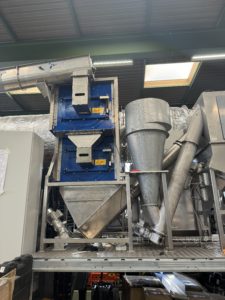 The materials are first crushed in one or two stages. Byproducts from logging undergo an initial coarse grinding process to produce wood chips with a particle size ranging from 30 to 60 mm. Next, the wood chips and other smaller residues (sawdust, shavings) are fed into a fine grinder that produces fibers of uniform size. Proxipel’s Proxiflex model accepts wood residues up to 50 mm in size into a hopper located at the rear of the trailer; then, the two refiner grinders mounted in series and integrated into the machine produce the particle size required for pellet production.
Drying
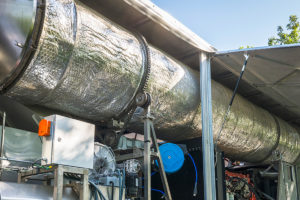 The finely ground material is dried in a drum dryer. This step, which consumes a great deal of energy, is very often carbon-neutral because it is fueled by other sawmill byproducts. At Proxipel, for example, the patented dryer integrated into the process can handle material with up to 50% moisture content, and the burner is fueled by a portion of the pellets produced (approximately 10%).
Granulation
At the heart of the process: the dry, graded material is fed into a pellet press. 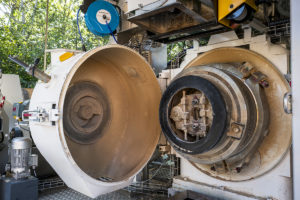
- It is extruded through a cylindrical die with holes ranging from 6 to 12 mm in diameter, depending on the desired pellet size. A blade cuts the pellets to a maximum length of 4 cm as they exit the die.
- Under the influence of pressure and heat (generated by friction), the wood’s natural lignin melts slightly, acting as an adhesive.
- The sawdust is then compacted and extruded into small wooden cylinders.
Key parameters to master:
- pressing temperature (~80 to 120 °C),
- rotational speed,
- quality of the programs,
- dietary consistency.
Cooling and Screening
The pellets come out of the press while they are still hot (70°) and slightly malleable.
- They pass through an air cooler, which mechanically stabilizes them. The cooling process ensures that the pellets achieve the desired hardness and completes the drying process, bringing the moisture content down to 5 to 10%.
- Next, the granules are conveyed to a screen, which separates them from the fines (dust) to retain only the product that meets specifications.
Packaging
The pellets are then:
- stored in bulk (silo) for delivery by blower trucks
- or packaged in bags (often 15 kg) primarily for the consumer market.
Transportation must be carried out with care to minimize the generation of fines (<ideally 1%).
Quality Criteria for Wood Pellets
To ensure optimal combustion and protect users’ equipment, several standards govern pellet quality. The majority of pellets on the French market (97%) are certified under the three existing standards: Dinplus, Enplus, and NF Biocombustibles Solides. In Europe, the benchmark is the ENplus A1 standard. The main criteria are:
| Criterion | Target value |
|---|---|
| Moisture | ≤ 10% |
| Ash content | ≤ 0.7% |
| Heating Value (PCI) | ≥ 4.6 kWh/kg |
| Fines content | ≤ 1% |
| Mechanical durability | ≥ 97.5% |
Compliance with these criteria ensures:
- clean combustion (less soot),
- optimal performance,
- longer service life for stoves and boilers.
Other factors may come into play when selecting pellets. See our article “How to Choose the Right Pellets”
Environmental Challenges and Outlook
Wood pellets are part of acircular economy:
- recycling of byproducts from sawmills,
- local production, short supply chains,
- replacement for fossil fuels.
However, the industry must ensure that:
- maintain a balance between resources and demand,
- ensure exemplary traceability,
- optimize the environmental performance of production facilities (particularly the energy used for drying).
Today, innovation focuses on:
- the development of pellets from alternative resources (hedgerow wood, hemp, bamboo, coffee grounds),
- integration into more comprehensive energy systems (heating networks),
- improving equipment efficiency (next-generation boilers).
Conclusion
Producing high-quality wood pellets is a demanding process that relies on the careful selection of raw materials, precise control of the industrial process, and compliance with the strictest standards.
At Proxipel, we leverage our expertise to help our clients find local, sustainable, and high-performance solutions for value creation. Thanks to our unique mobile technology, we process wood waste directly on-site, reducing logistics costs and our carbon footprint.
Would you like to learn more about our approach? Find out how to maximize the value of your forest by-products, agricultural residues, or sawmill by-products?
Contact our teams: we’d be delighted to advise you and work with you to develop customized solutions.
