
Wood pellet wood pellets—also known as pellets—is growing in popularity due to its environmental and economic benefits. However, to ensure optimal efficiency and protect your system, it’s essential to choose the right pellets. Here are the criteria to consider when making your selection.

Understanding What a Wood Pellet Is
Pellets are small cylinders made from compressed sawdust, without the addition of glue or chemical additives. They are used as fuel in pellet stoves, boilers, or inserts. Their quality directly affects the appliance’s efficiency, the cleanliness of combustion, and the system’s longevity.
Choose a recognized certification
The first selection criterion is certification, which guarantees the quality of the pellets and their compliance with specific standards. There are three main certifications:

- DINplus (Germany): ensures consistent quality, low ash content, good density, and high calorific value.
- ENplus (European standard): classifies pellets into different categories (A1, A2, B), with A1 being the best for residential use.
- NF Solid Biofuels (France): a French certification label guaranteeing a high-quality product.
Choose ENplus A1 or DINplus-certified pellets, which guarantee performance and safety.
Review the technical specifications
In addition to certification, several technical characteristics must be examined:
- Gross calorific value (GCV): It must be at least 4.6 kWh/kg. The higher it is, the more heat the pellets produce.
- Moisture content: ideally less than 10 %. Pellets that are too moist burn poorly and clog your appliance.
- Ash content: A good pellet produces little ash (less than 0.7%), which reduces the need for cleaning.
- Fine particle (dust) content: the lower, the better. A content of less than 1% is recommended to prevent jams.
Check the raw material
The best pellets are made from untreated virgin wood, usually softwood (fir, spruce, pine). Hardwood can also be used, but it sometimes produces more ash. Be wary of pellets made from recycled wood or shredded pallets: they may contain adhesives or varnishes that are harmful to your stove and your health.
Prioritize local and responsible production
To reduce your carbon footprint and support the local economy, choose pellets produced through local producers. Find out about the wood’s origin and forest management practices. Some producers display sustainability commitments, such as PEFC or FSC certification, which guarantee responsible forest management.
Choosing the Right Packaging
Pellets are sold in 15-kg bags, on pallets (averaging 1 metric ton), or in bulk for large-scale installations. For residential use, bags are convenient to store and handle. Make sure the bags are moisture-resistant and properly sealed. Store them away from water to prevent swelling or deterioration. Bulk pellets are typically delivered by a blower truck.
Compare prices—but that’s not all
The price of a pellet varies depending on the season, demand, and packaging. Don’t be tempted solely by the lowest price. A low-quality pellet will cost you more in the long run (maintenance, breakdowns, and higher consumption). A good value for the money, based on technical criteria and certifications, is the best strategy.
Comparison Chart and Criteria for Choosing Pellets
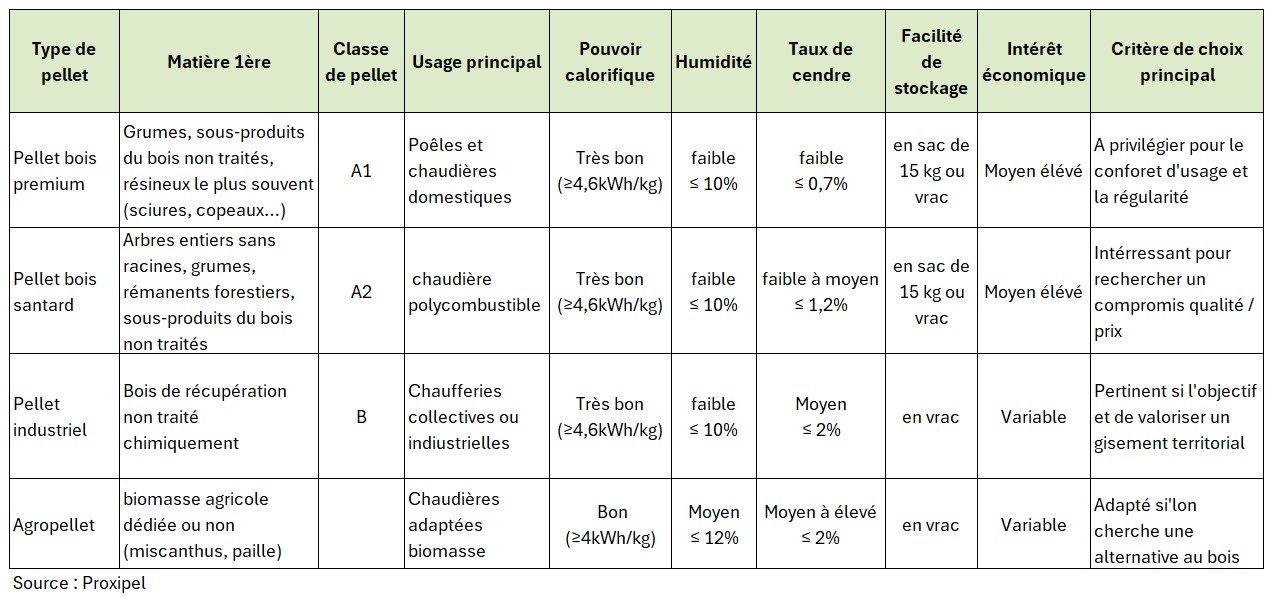
How do I read this pellet comparison?
For a wood-burning stove or home heating boiler, premium wood pellets are generally the gold standard.
For a multi-fuel boiler room, other types of pellets may be considered, particularly those made from forest residues or agricultural biomass.
For a byproduct valorization project, the best pellet isn’t always the “premium” one, but rather the one that offers the best balance between available supply, logistics costs, market opportunities, and technical compatibility.
In conclusion
Choosing the right wood pellets is essential for efficient, economical, and eco-friendly heating. By relying on recognized certifications and precise technical specifications, and by prioritizing high-quality wood sourced from responsible suppliers, you’ll ensure optimal performance from your heating system and long-lasting warmth.
At Proxipel, we believe that there is no single type of pellet, but rather pellets tailored to different resources and uses. Clean sawdust intended for home heating does not meet the same requirements as pellets made from miscanthus or straw. The challenge, therefore, is not simply to pelletize, but to design the right value chain based on the actual characteristics of the biomass available in the field.
The PROXIPEL mobile, all-in-one pelletizing solution processes forest residues, grapevine prunings, woody agricultural residues, and branches from compost piles. The wood pellets produced by PROXIPEL comply with the international ISO 17225 standard.
