
Turning Chicken Manure into Pellets: A Sustainable and Profitable Solution for Farmers and Agricultural Cooperatives
Chicken manure: an organic treasure that remains underutilized
Each bird produces between three and five kilograms of manure per month. Across French poultry farms, this amounts to more than three million metric tons of manure per year. Long considered waste, this manure is actually an agronomic resource with great potential, rich in essential nutrients (nitrogen, phosphorus, potassium, trace elements, etc.). In a context where agriculture seeks to balance productivity, self-sufficiency, and sustainability, processing poultry manure into pellets appears to be a win-win solution. It addresses environmental challenges while offering a new avenue for economic value creation for farmers and cooperatives.
Why turn chicken manure into pellets?
Mobile granulation allows manure to be dried, ground, and compressed into a concentrated, stabilized organic fertilizer. This process transforms wet, bulky, and odorous waste into a dry, stable, and easy-to-store product.
According to a study conducted by ITAVI, IRSTEA, and the Brittany Regional Chamber of Agriculture (Ponchant et al., 2017), the pelletization of poultry manure produces an effect comparable to rapid composting, resulting in the stabilization of the material and a slight reorganization of nitrogen. This process helps sanitize the material, reduce odors, and produce a stable, standardized product that is easy to apply and complies with the NFU 42-001 standard for organic fertilizers.
A nutrient-rich organic fertilizer
Granulated chicken manure is one of the most nutrient-rich soil amendments. Its composition depends on the poultry’s diet, but generally includes: nitrogen (N), phosphorus (P), potassium (K), organic matter, and trace elements (Ca, Mg, S). This rich composition gives the pellets high fertilizing power, making them ideal for vegetable, fruit, grape, and ornamental crops.
See also: Benefits of Granular Fertilizers
Agronomic and Environmental Benefits
The use of chicken manure pellets offers multiple benefits: gradual and long-lasting fertilization, improved soil structure, stimulation of biological activity, reduced reliance on chemical fertilizers, and the creation of a circular resource that is locally valued.
Agricultural Uses of Chicken Manure Pellets
This versatile fertilizer can be used on a wide range of crops: vineyards, orchards, vegetable gardens, field crops, lawns, and ornamental plants. Recommended application rates range from 500 to 1,500 kg/ha, depending on soil type and crop. It can easily be stored for two years in a dry, well-ventilated area. This allows farmers to optimize their purchases and inventory while benefiting from a ready-to-use product that is compatible with standard spreaders.
The Economic Benefits for Livestock Farmers
Thanks to on-site pelletization, farmers reduce their transportation, storage, and spreading costs. The pellets can be reused on-site or sold to cooperatives and neighboring farmers, thereby creating a new local source of income. The case study below illustrates the potential added value for a livestock farmer when processing 500 metric tons of manure into pellets.

A Best-Practice Model for Agricultural Cooperatives

Cooperatives can invest in a mobile pelletizing unit to provide local service, reduce logistics flows, and strengthen fertilizer self-sufficiency. The reuse of manure is also part of their CSR strategy: reducing chemical inputs, limiting transportation, and promoting local reuse. The pellets produced by one farmer can be redistributed to other members who lack manure, fostering solidarity among members and a circular economy within the region.
The Proxipel Solution: The mobile granulation plant
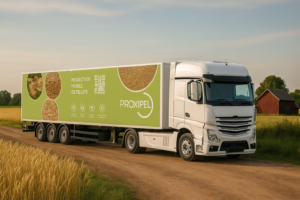
Proxipel has designed a mobile unit capable of processing poultry manure, agricultural residues, or wood waste on site. With a production capacity of one to two metric tons of pellets per hour, this solution stabilizes the material, eliminates the need to transport wet materials, and integrates seamlessly into local short supply chains.
The steps in the production of chicken manure pellets:
- Natural pre-drying: reducing the moisture content to 40%
- Grinding: homogenization of the material
- Drying: reducing the moisture content to 10–15%
- Pressing: granulation of my material
- Cooling and Screening of the Granules
Discover: Proxiflex, Proxipel’s mobile granulation technology
Conclusion: Brown Gold Supporting the Agricultural Transition
Granulated chicken manure illustrates the potential of circular, carbon-neutral agriculture. It enables farmers to reduce their costs, improve their environmental footprint, and create local added value. For cooperatives, it is a powerful CSR tool and an opportunity to build sustainable organic fertilizer supply chains.
