
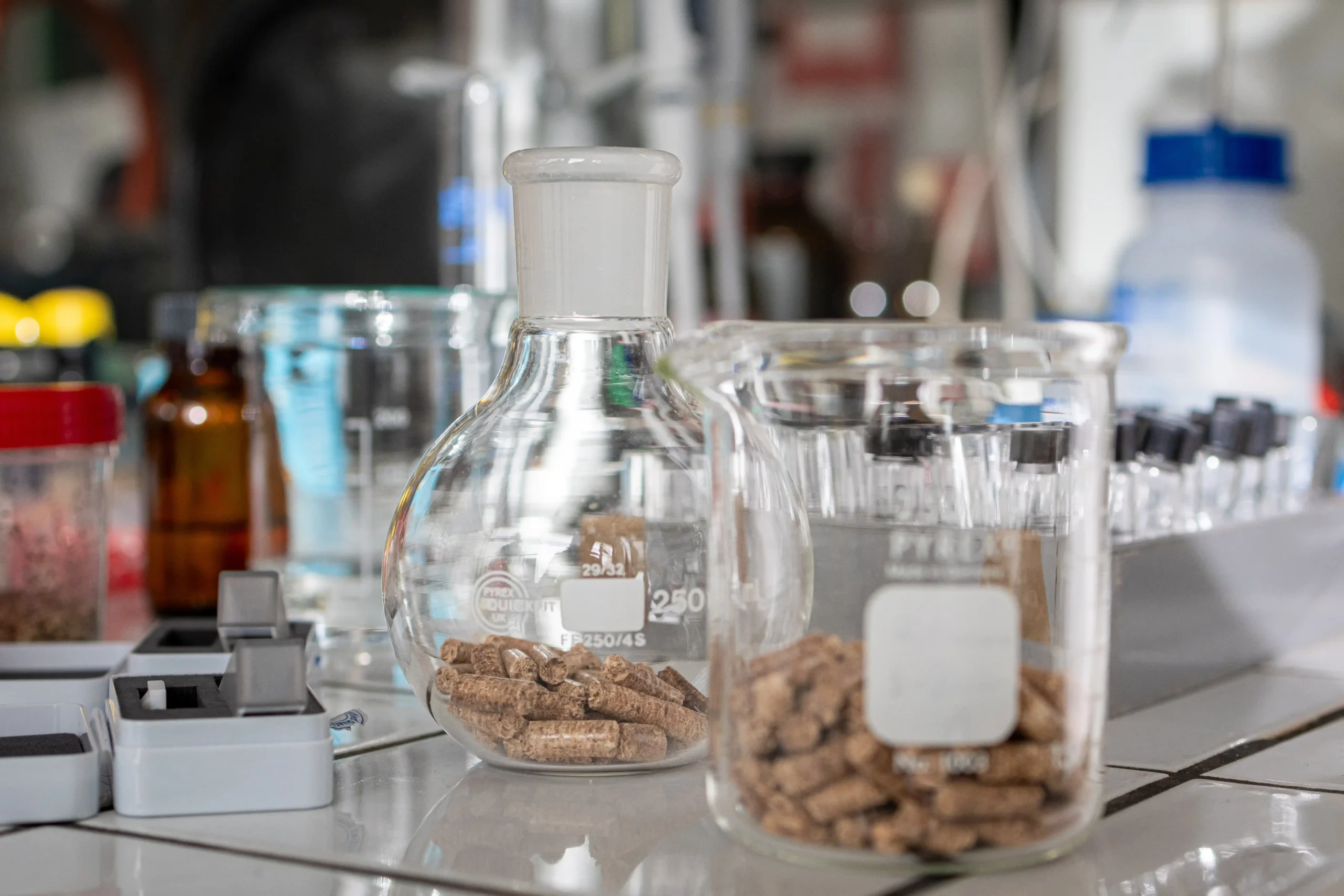
Granulation increases extraction yields
Biorefineries, a key tool in the energy transition…that are hampered by their production costs:
The transition to a bio-based, low-carbon economy depends on the ability to replace petrochemical resources with local, renewable biomass. However, unlike the petrochemical industry—which has been highly industrialized and optimized for over a century—the bio-based sector faces major challenges across the entire value chain:
- Collection and logistics: Biorefineries around the world consume thousands of metric tons of biomass every day (ranging from 1,800 to 4,500 metric tons per site, according to Axelos et al., 2020), a resource that is scattered, seasonal, moist, and perishable, making it difficult to ensure a continuous and consistent supply;
- Processing and yield: The complex and variable composition of biomass, its low concentration, and its moisture content affect the efficiency and viability of industrial processes;
- Adapted industrial organization: The spatial and temporal variability of raw materials requires new management strategies and customized technologies to optimize material and energy flows.
As a result, emerging biorefineries are struggling to achieve competitiveness, reliability, and sustainability—major obstacles to the growth of the bioeconomy, despite its strategic economic and environmental potential for France and Europe (SNMB, European Green Deal).
Securing Supplies
Process Efficiency
Integration & Circularity
A discovery that significantly impacts extraction yields at biorefineries:
Our research, which initially focused on methodsfor extractingpolyphenols from grapevine shoots, led to an unexpected discovery regarding the pretreatment of biomass.
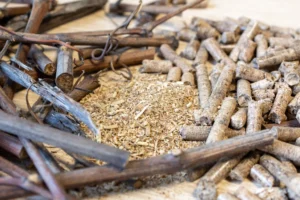
Beyond the well-known logistical benefits of granulation —
- A 5-fold reduction in the volume of goods transported and stored,
- Natural stabilization of biomass through drying,
- Production of a homogeneous, dry, ready-to-use intermediate
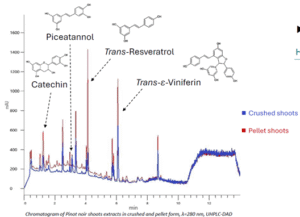
Figure 1: The granulation method increases the availability of virtually all polyphenols of interest derived from grapevines, including resveratrol
We have shown that, under certain granulation conditions, the extraction yield of the molecules of interest increases by 25 to 30 percent.
This improvement is significantly greater than that achieved through heat treatment, pressure treatment, or even a combination of the two, thanks to a specific mechanical effect of granulation that breaks down the lignocellulosic matrix, ruptures the cell walls, and more effectively releases the biological components.
The use of this technology would directly impact the efficiency of biorefineries and would enable:
- a decrease in CAPEX for the construction of new biorefineries,
- an increase in productivity at existing facilities, without additional investment
- and a major simplificationof biomass collection and processing, from the field to the plant.
This discovery paves the way for an integrated optimization of the bio-based supply chain that is more efficient, cost-effective, and sustainable, and can be applied to a wide variety of plant resources.
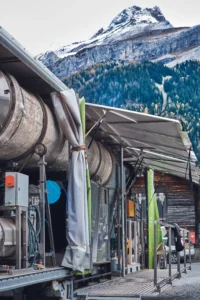
Proxipel offers the first fully integrated mobile granulation unit:
To actually deploy this technology in the field, we have developed a mobile granulation and drying unit capable of operating directly at biomass production sites (farms, vineyards, forests, agri-food facilities, etc.).
This compact, self-contained unit allows you to:
- the immediate processing of biomass on site, without the need for prior transportation or heavy infrastructure,
- A granulation recipe specific to each type of biomass, directly integrated into the unit’s PLC, that is fully repeatable without manual intervention. This allows for great versatility.
- a drastic reduction in the volume to be transported (up to 80% less mass),
- stabilizingand standardizing the product before shipping it to biorefineries,
- and the production of a dry, uniform granule ready for extraction.
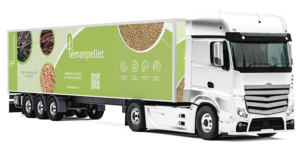 Thanks to this mobile and modular approach, it becomes possible to process scattered feedstock sources locally, thereby securing supply for biorefineries and reducing their carbon footprint.
The mobile unit thus serves as a strategic link between biomass production and its industrial processing, combining operational efficiency, energy efficiency, and the creation of local value.
 We are looking for:
Proxipel, an expert in biomass granulation, is seeking strategic industrial partners active in the cosmetics, extraction, and pharmaceutical sectors who wish to leverage this discovery to:
- Optimize the operation of their biorefineries,
- Reduce their production costs,
- Secure their biomass supplies,
- and make the most of new local resources.
This collaboration will enable us to quickly scale the technology to an industrial level, while generating significant operational and economic benefits for our partners. Interested? Contact us!
